What is GST and How to Use a GST Calculator
By Instant Tools Hub Team · Published: 27 May 2026 · 6 min read
What Is GST? A Simple Explanation
GST stands for Goods and Services Tax. It is a comprehensive indirect tax levied on the supply of goods and services across India. Introduced on 1 July 2017, GST replaced a complex web of central and state taxes — including Central Excise, Service Tax, VAT, Entry Tax, and Octroi — with a single, unified tax structure. The core idea is "one nation, one tax," making it easier for businesses to operate across state borders and reducing the cascading effect of multiple taxes on a single product.
GST is a consumption tax, meaning it is ultimately borne by the end consumer. Businesses collect GST from their customers, deduct the GST they have already paid on their purchases (called "Input Tax Credit" or ITC), and pay the net difference to the government. This mechanism prevents double taxation and keeps the tax burden proportional to the actual value added at each stage of the supply chain.
CGST, SGST, and IGST — What Is the Difference?
GST has a dual structure because India is a federal nation with both central and state governments having the right to levy taxes. The division depends on whether a transaction is within a state or between states:
- CGST (Central GST): Collected by the Central Government on intra-state (within the same state) transactions. If you buy a product from a seller in the same state, CGST is charged.
- SGST (State GST): Collected by the State Government on the same intra-state transaction. CGST and SGST are always equal — if the total GST rate is 18%, it is split as 9% CGST + 9% SGST.
- IGST (Integrated GST): Collected by the Central Government on inter-state (between two different states) transactions, including imports. The IGST rate equals the total GST rate (e.g., 18% IGST instead of 9% CGST + 9% SGST). IGST is later divided between the centre and destination state.
- UTGST (Union Territory GST): Applies in Union Territories (Delhi, Chandigarh, Puducherry, etc.) in place of SGST for intra-UT transactions.
For practical calculations using our GST Calculator, you only need to know the total GST percentage applicable to your product or service. The CGST/SGST/IGST split is relevant primarily for GST filing and invoicing.
GST Slabs in India — Which Rate Applies to What?
India uses a multi-tier GST rate structure based on the nature of goods and services. There are five main rate slabs:
- 0% GST (Exempt): Essential goods and services — fresh fruits and vegetables, milk, eggs, cereals, bread, educational services, healthcare services, and government-provided services. No GST is charged on these.
- 5% GST: Packaged food items (sugar, tea, coffee, edible oil), transport services (railways, economy-class airfare), renewable energy devices, and some medicines.
- 12% GST: Processed foods (butter, ghee, cheese, fruit juices), business-class airfare, non-AC hotels, mobile phones (historically; rates change with GST Council revisions), and certain construction materials.
- 18% GST: The most common rate, covering a wide range of goods and services — IT services, software, most financial services, restaurant dining, camera equipment, paint, iron and steel, FMCG products, and mid-range hotels.
- 28% GST: Luxury and sin goods — luxury cars, premium motorcycles, tobacco products, aerated drinks, pan masala, cement (historically), and five-star hotel stays.
Additionally, some luxury goods attract a Compensation Cess on top of the 28% rate — for example, cigarettes and large SUVs. GST rates are periodically revised by the GST Council, so always verify the current rate for your specific product category.
How to Use the GST Calculator — Add and Remove GST
The GST Calculator on Instant Tools Hub handles two scenarios: adding GST to a base price (exclusive), and removing GST from a price that already includes it (inclusive).
Scenario 1: Adding GST to a base price (GST Exclusive)
Use this when you have the price before GST and want to know the final price a customer pays.
- Enter the base price — e.g., ₹10,000
- Enter the GST rate — e.g., 18%
- Select "Add GST" or "GST Exclusive"
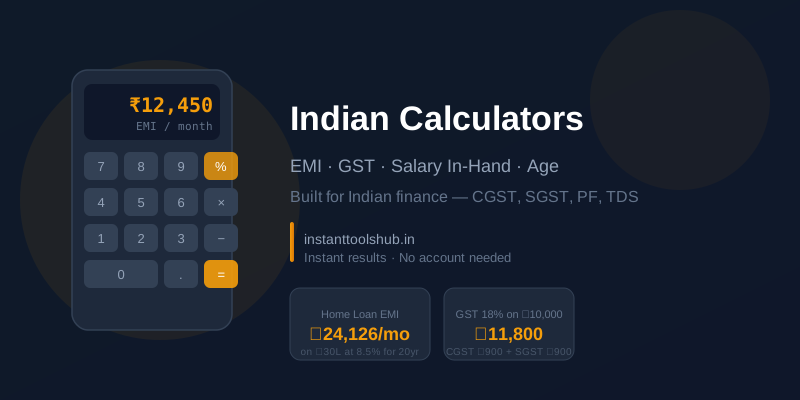
- Result: GST amount = ₹1,800 | Total price = ₹11,800
Scenario 2: Removing GST from a total price (GST Inclusive)
Use this when you have the final price including GST and need to calculate the base price and the GST component — common for accounting, invoicing, and ITC claims.
- Enter the total price — e.g., ₹11,800
- Enter the GST rate — e.g., 18%
- Select "Remove GST" or "GST Inclusive"
- Result: Base price = ₹10,000 | GST amount = ₹1,800
The formula for removing GST is: Base Price = Total Price ÷ (1 + GST rate/100). So for 18% GST: ₹11,800 ÷ 1.18 = ₹10,000.
Real-World GST Examples
Let us walk through a few practical examples that Indian freelancers, business owners, and consumers encounter regularly:
- Freelancer invoice: A freelance graphic designer charges ₹25,000 for a logo design project. IT services attract 18% GST. GST amount = ₹4,500. Total invoice amount = ₹29,500. If the client is GST-registered, they can claim ITC on the ₹4,500.
- Restaurant bill: A non-AC restaurant charges 5% GST. A ₹800 meal adds ₹40 GST, for a total of ₹840. An AC restaurant charges 18% GST — the same ₹800 meal would cost ₹944.
- Online shopping: A mobile phone priced at ₹15,000 on Flipkart includes 12% GST. The base price = ₹15,000 ÷ 1.12 = ₹13,393. GST component = ₹1,607.
- Hotel booking: A hotel room at ₹5,000/night falls under the 12% GST slab (non-luxury). GST = ₹600. Total per night = ₹5,600. A room priced above ₹7,500 attracts 18% GST.
Summary
GST is a critical part of doing business and everyday consumer transactions in India. Whether you are a business owner creating invoices, a freelancer calculating your billing, or a consumer checking if your receipt is correct, knowing how GST works saves money and prevents errors. Use the free GST Calculator on Instant Tools Hub to instantly add or remove GST from any amount, verify tax components, and create accurate invoices — no manual calculations required.